Shoecounter anti-robot riot
The Caves of SteelThe Shoecounter anti-robot riot begins as a dispute over who may serve customers in a New York City shoe store and escalates into a crowd threatening the robots inside. R. Daneel Olivaw ends the immediate danger not through violence but by making the crowd believe that he will use force. For Elijah Baley, the episode is also a test of authority: he allows his robot partner to take charge, then recoils from the relief he felt when the robot succeeded.
Background and Escalation
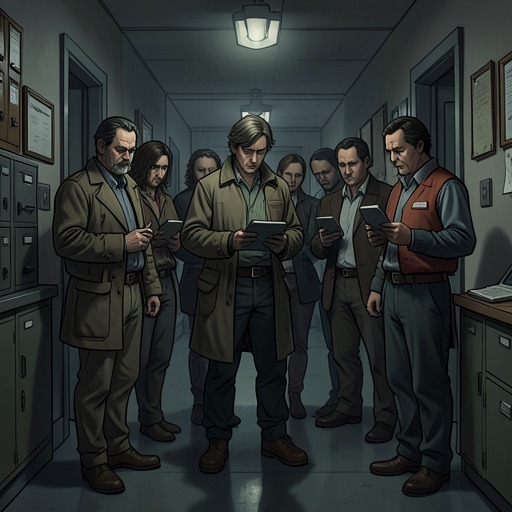
As Elijah Baley and R. Daneel Olivaw approach the elevator banks near Baley’s home, they encounter a gathering outside a brightly lit retail department. A bystander reports that robots are inside, and another voices a wish to dismantle them. Baley looks anxiously toward Daneel, who gives no outward sign that he has heard or understood the threat. Baley then pushes into the crowd, identifying himself as a police officer.
Inside, the store is less crowded than the street. The manager has already lowered the force door, keeping potential troublemakers out but also trapping those involved in the argument. Baley enters with his officer’s neutralizer; Daneel follows and pockets a smaller, neater neutralizer of his own. The manager protests that the City assigned him his clerks and that he is entitled to employ them.
The dispute is sharpened by a customer who demands a human clerk and challenges the robots’ status as men. She accuses them of taking jobs from people and blames the government for protecting them, linking robot employment to families’ hardship and their dependence on yeast food. Her denunciation turns a disagreement over service into an attack on the social place of robots, while the rumble of the crowd outside continues to grow.
The Crowd Enters
Daneel orders the manager to act under the authority of the law. The manager warns that he will hold the City responsible for damage, but the barrier goes down and people press into the store, celebrating what they take to be a victory. Baley knows from earlier riots how quickly such a crowd can move from attacking robots to destroying anything within reach. Here, however, the threat is contained before that destruction begins.
Daneel raises his voice and warns that the next person to move will be shot. Someone in the crowd shouts for the others to get him, yet no one moves at first. The woman who had attacked the robots breaks the pause by panicking and trying to leave; unable to get through the packed crowd, she sinks to her knees. The crowd begins to retreat.
Daneel then jumps down from the display counter and announces that he will walk to the door, shooting anyone who touches him. He also threatens those who remain in place rather than going about their business, and singles out the frightened woman. She insists that she meant no harm and wants to go home. Baley opens his eyes to find that the people are dispersing. The scene ends without the threatened violence being carried out: the manager adjusts his clothes and hair, muttering threats at the departing crowd.
Baley and Daneel’s Reversal of Authority
Baley recognizes that he could have stopped Daneel at the outset or called for a squad car. Instead, he leaves the responsibility with the robot and feels relief. He cannot accept his own attempted excuse that Daneel’s personality simply dominated the situation; the fact that a robot dominated it fills him with self-loathing. The episode therefore does more than demonstrate Daneel’s capacity to control a crowd. It shows Baley’s conflict between the need for effective police action and his discomfort at depending on a machine to provide it.
The store’s force door, initially lowered to prevent trouble, becomes a practical constraint when it also keeps people inside. When it is lowered and the crowd enters, the episode’s balance of power turns abruptly: a contained dispute becomes an exposed confrontation. Daneel’s threats reverse that momentum without physical force, while Baley remains the human officer who has allowed the robot to determine how the crisis will be handled.
Wider Stakes and Significance
The store confrontation gives a public, immediate form to the employment resentment voiced by the customer. Her complaints connect robot clerks to perceived job losses, government protection, and the conditions faced by struggling families. The episode does not resolve those broader grievances; instead, it shows how quickly they can become hostility toward individual robots when a crowd gathers around a local dispute.
That tension belongs to the larger investigation, which is politically fraught because the murder of a Spacer has made responsibility and jurisdiction matters of interplanetary consequence. The Commissioner explains that Spacetown falls within New York jurisdiction, although the Spacers possess extraterritorial rights and can conduct their own investigation. The Outer Worlds could use the case to demand indemnity, creating political danger whether Earth agrees to pay or refuses. Against this backdrop, the shoe-store riot is not merely a disturbance: it reveals the volatile public hostility surrounding robots at the very moment Earth’s handling of relations with the Spacers is under scrutiny.
The later investigation makes the limits of authority visible in a different way. In the confrontation with Dr. Han Fastolfe, Baley asserts that Daneel has no status as a witness in an Earth court. The two scenes place Daneel in contrasting positions: at the shoe counter his authority can disperse a crowd, but in court his testimony would carry no legal standing. The incident thus dramatizes a gap between practical power and formal recognition, while leaving Baley to reckon with the fact that the robot beside him can sometimes command a situation he himself has not controlled.